See through different eyes
What Tritanopia (strong) looks like
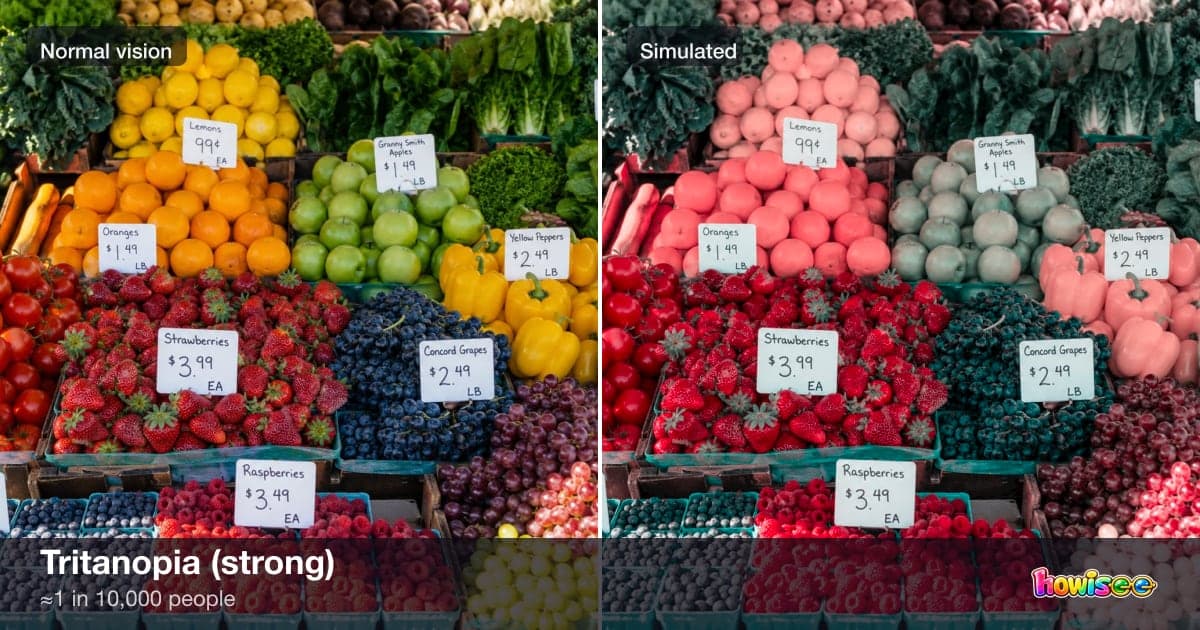
Blues and yellows are hard to distinguish, and blue-green looks similar.
≈1 in 10,000 people · NEI · Learn more
What it is
The short-wavelength cones, tuned to blue, are absent or non-functional. This affects the blue-yellow axis rather than red-green, which makes it the rarest and least familiar of the dichromacies. The S-cones are also the sparsest cone type in a typical retina, which is part of why blue vision is the most fragile.
What it looks like day to day
Blue and green become hard to separate, as do yellow and pink or violet and red. The sky can read as a pale green, and blue-green shades in particular tend to look like one colour. Because so much interface design assumes blue is instantly recognisable, blue-on-dark indicators and links can be surprisingly hard to pick out.
What helps
The same strategies as red-green deficiency apply: rely on labels, brightness and position rather than hue. Acquired blue-yellow difficulty is sometimes a sign of another eye condition, so eye doctors treat a new change in blue vision differently from a lifelong one.
Who it affects
Roughly 1 in 10,000 people. Unlike red-green deficiency it is not carried on the X chromosome, so it affects men and women about equally, and a single copy of the gene variant is enough to cause it.
Related conditions
Explore every condition or learn about color blindness.
This is an approximation, not a medical diagnosis.