See through different eyes
What Protanopia (strong) looks like
Reds look dark and muddy, and reds and greens are hard to tell apart.
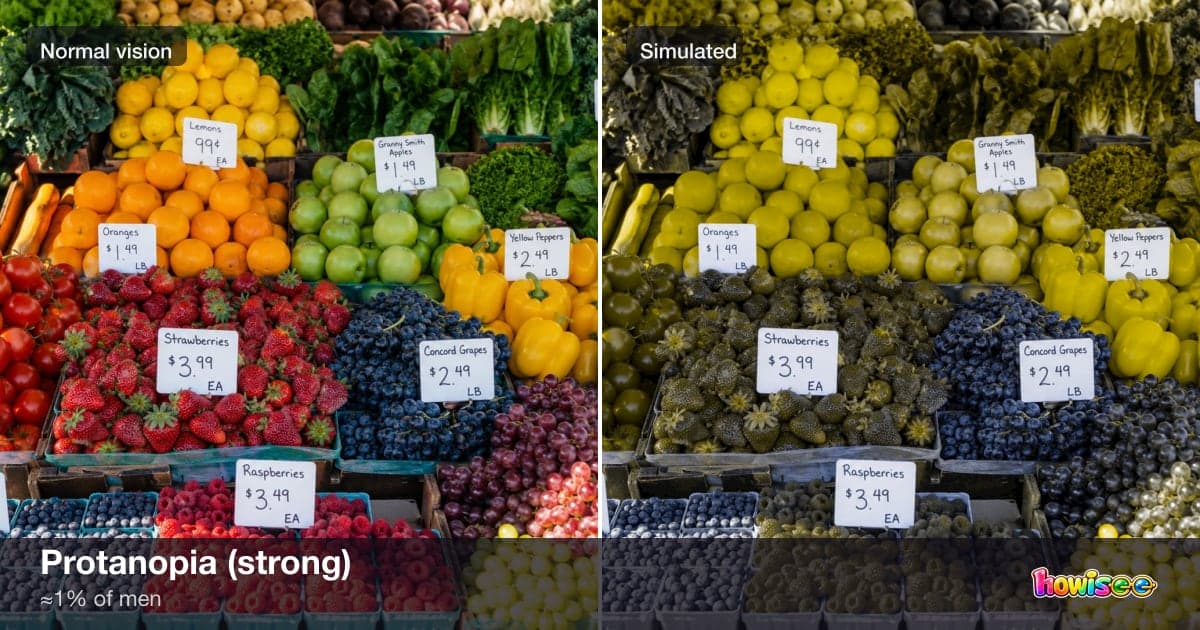
≈1% of men · NEI · Learn more
What it is
The eye has three kinds of cone cell, each tuned to a different part of the spectrum. In protanopia the long-wavelength cones, the ones most sensitive to red light, do not function at all. Colour is still seen, but it is assembled from two signals instead of three, and the entire red end of the spectrum loses both its hue and much of its apparent brightness.
What it looks like day to day
Red things look dark rather than red: a ripe tomato can read as near-black against its leaves, and brake lights are dimmer than they are for everyone else. Red, orange, brown and green collapse toward one another, so a red pen on a green desk mat is a matter of finding the shape rather than the colour. Purple tends to look blue, because the red component of it is missing.
What helps
Most people navigate by brightness, position and context instead of hue, often without consciously deciding to. Labelling, sorting by placement rather than colour, and phone camera apps that name colours all get used. Tinted lenses are marketed for red-green deficiency and some people like them, but they shift colours around rather than restoring the missing signal.
Who it affects
Around 1% of men. The genes for the red and green cones sit on the X chromosome, and men have only one, so a single altered copy is enough. Women need both copies affected, which is far rarer. It is present from birth and does not progress.
Related conditions
Explore every condition or learn about color blindness.
This is an approximation, not a medical diagnosis.