See through different eyes
What Deuteranopia (strong) looks like
Greens and reds blend together. This is the most common form of color blindness.
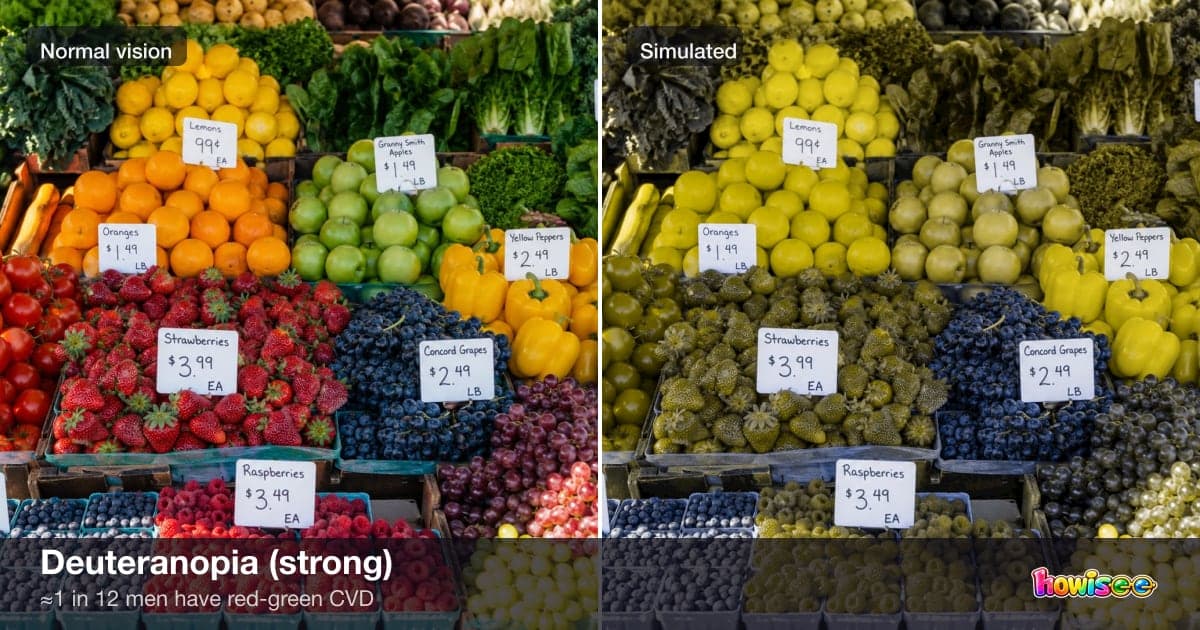
≈1 in 12 men have red-green CVD · NEI · Learn more
What it is
The medium-wavelength cones, the ones tuned to green, are absent. As in protanopia, colour vision is built from two cone signals rather than three, and the red-green axis of colour collapses. Unlike protanopia, brightness is largely preserved, so reds stay about as bright as they should be while losing their distinctness.
What it looks like day to day
Greens and reds run together, and so do the colours between them. Traffic lights are read by position rather than colour. Ripeness is hard to judge on fruit, and colour-coded charts, transit maps and status indicators frequently fail to communicate what they were designed to. Pink and grey can be difficult to separate, as can purple and blue.
What helps
Design that does not rely on colour alone helps most: labels, shapes, patterns and position. Many people use a phone camera to identify a colour when it matters. Some report that colour-filtering glasses increase the separation between confusable colours, though they do not add the missing cone back.
Who it affects
Around 1% of men, with the milder deuteranomaly considerably more common. Like protanopia it is X-linked and present from birth. Together the deutan forms account for most colour vision deficiency.
Related conditions
Explore every condition or learn about color blindness.
This is an approximation, not a medical diagnosis.