See through different eyes
What Deuteranomaly (moderate) looks like
A milder green-weak shift, and the most common color vision deficiency.
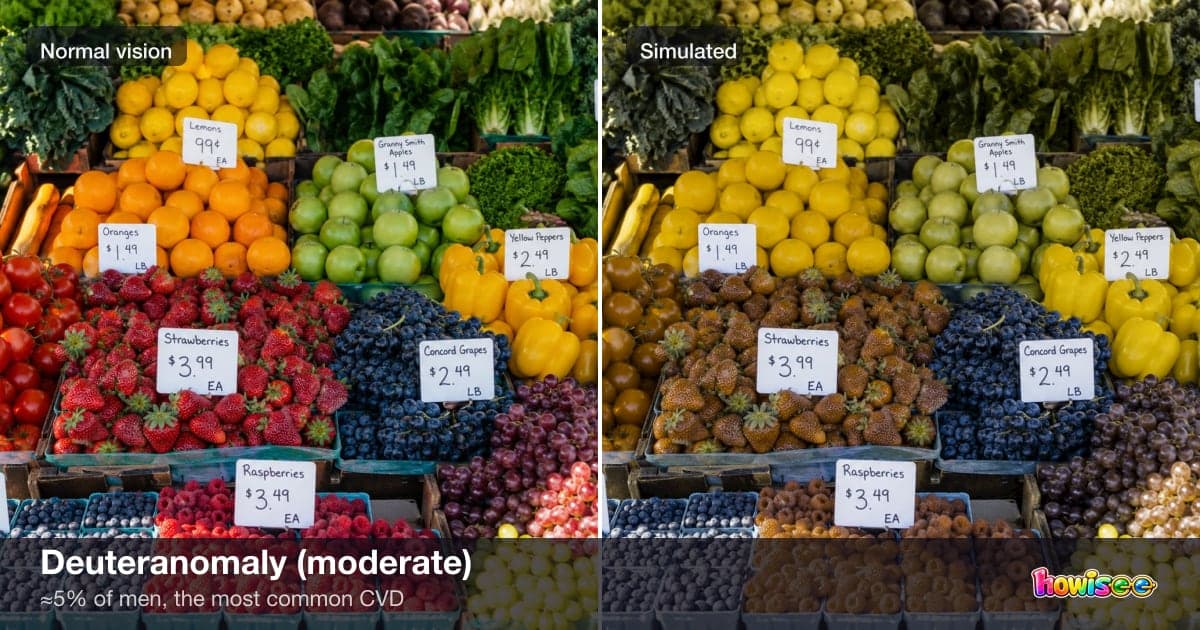
≈5% of men, the most common CVD · NEI · Learn more
What it is
The green-sensitive cones are present but their sensitivity has shifted toward red, narrowing the gap between the two signals the eye uses to judge red from green. This is the most common form of colour vision deficiency by a wide margin, and also the mildest in most people who have it.
What it looks like day to day
Greens and reds are distinguishable but less confidently, especially at low saturation, in poor light, or across small areas like a status dot or a line on a chart. Many people describe it less as confusing colours and more as being unsure, and checking twice.
What helps
Because the deficiency is one of degree, lighting and size matter: the same colours that are ambiguous on a small badge may be obvious on a large surface. Interfaces that pair colour with a label or an icon remove the problem entirely.
Who it affects
About 5% of men, which is roughly one in twenty. In a room of forty men, the odds are that two of them share it. X-linked and present from birth.
Related conditions
Explore every condition or learn about color blindness.
This is an approximation, not a medical diagnosis.