See through different eyes
What Blue cone monochromacy looks like
Only blue-sensing cones work, so almost no color remains
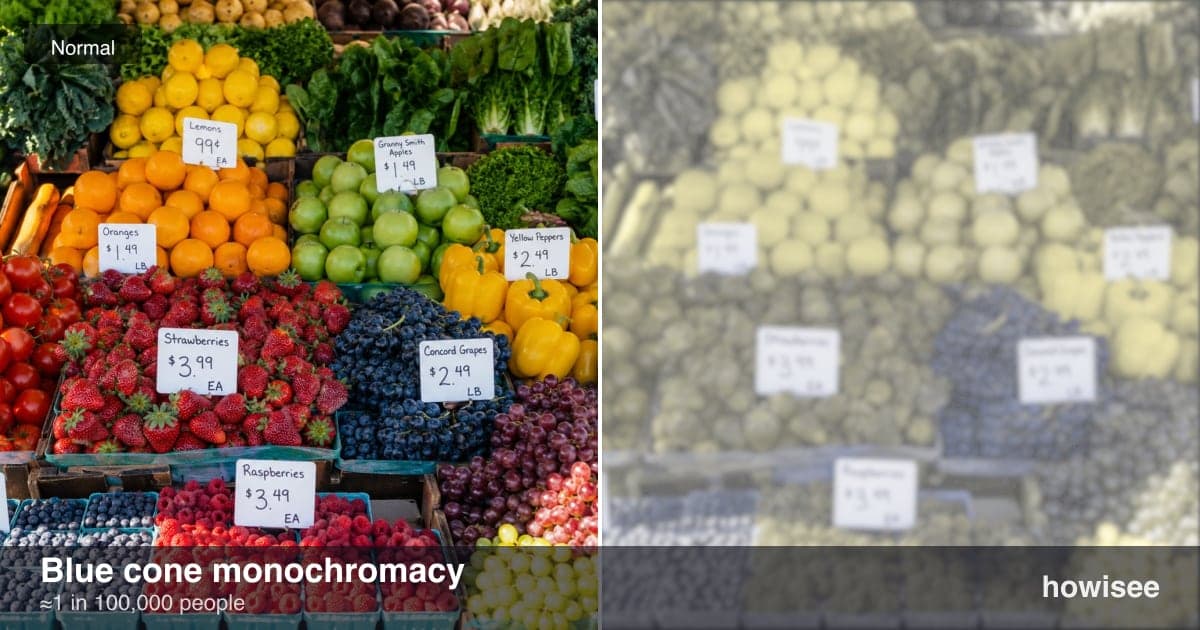
≈1 in 100,000 people · MedlinePlus · Learn more
What it is
Neither the red-sensing nor the green-sensing cones function, leaving only the blue-sensing cones and the rods. It sits between dichromacy and total colour blindness: one cone type still works, so a thin sliver of colour vision survives along the blue-yellow axis, but the red-green axis is gone completely rather than merely compressed.
What it looks like day to day
Most of the world reads as shades of grey with a faint blue or yellow cast to it. Because the S-cones are the sparsest cone type and contribute little to fine detail, acuity is reduced as well, so small print is difficult independently of colour. Bright light is uncomfortable, and vision is often clearer in dimmer conditions than in full sun.
What helps
Tinted lenses, often red or magenta, are commonly used to bring light down to a workable level and are reported to improve contrast. Magnification helps with the reduced acuity, and the same colour-independent strategies used for other deficiencies apply: labels, position and brightness rather than hue. Gene therapy is an active area of research.
Who it affects
Around 1 in 100,000 people, which makes it considerably rarer than achromatopsia. It is X-linked, so it affects men far more often than women, and it is present from birth rather than acquired.
Related conditions
Explore every condition or learn about color blindness.
This is an approximation, not a medical diagnosis.