See through different eyes
What Achromatopsia looks like
Complete color blindness with light sensitivity
≈1 in 30,000 people · MedlinePlus · Learn more
What it is
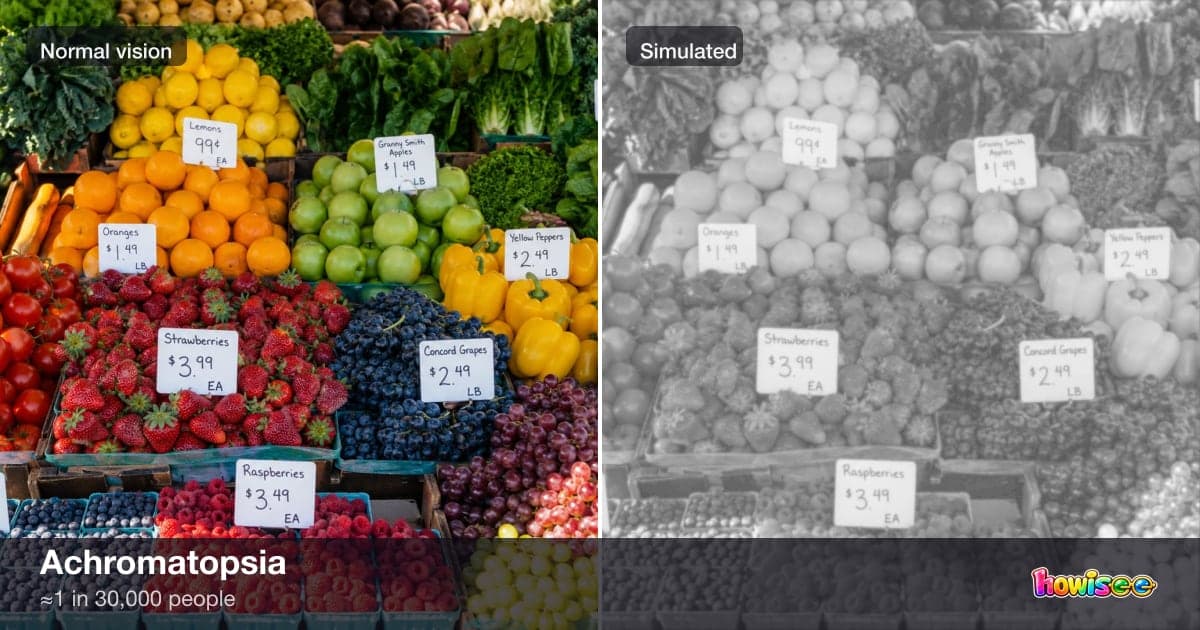
None of the cone cells function, so vision runs almost entirely on the rods, which are the cells built for low light and do not carry colour information at all. The world is seen in shades of grey. Because rods saturate in bright conditions, ordinary daylight is genuinely overwhelming rather than merely uncomfortable.
What it looks like day to day
Bright light is the dominant difficulty: outdoors on a clear day, vision can wash out almost completely, and many people are most comfortable in dim conditions. Visual acuity is typically reduced, and involuntary eye movement is common. Colour is not dulled but absent, so it plays no part in recognising or sorting anything.
What helps
Dark or red-tinted lenses are widely used to bring light down to a workable level, and many people prefer to sit away from windows and use lower screen brightness than others find comfortable. Magnification is common for reading, given the reduced acuity.
Who it affects
Roughly 1 in 30,000 people. It is inherited recessively, meaning both parents carry a copy, and it is present from birth rather than acquired.
Related conditions
Explore every condition or learn about color blindness.
This is an approximation, not a medical diagnosis.